
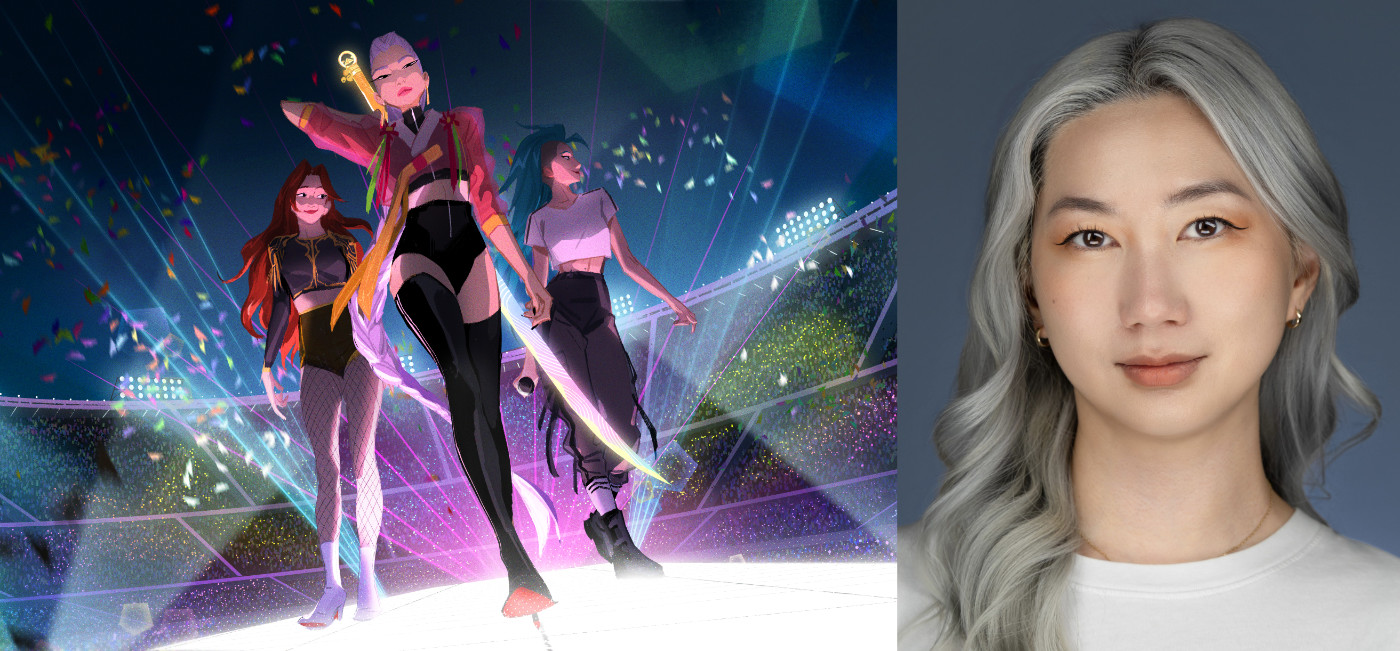
KPop Demon Hunters was the smash hit animated Netflix sensation of 2025. It was nominated for a ton of awards, won both Best Animated Feature and Best Original Song at the Oscars, racked up hundreds of millions of views, and its songs were massively popular in their own right as well. One of the major forces behind the film was production designer Mingjue Helen Chen.
A couple months ago, we interviewed her to ask about her background, inspiration, and if she has any career advice for early-stage creatives. Click here to read that interview. We also asked her to break down her creative process so we can all learn from her example! Check out the five-video series she did explaining her process below.
Part 1: Composition
Helen always starts off with a scene in her head, usually a pretty neutral one, so she can line up all of the elements before she begins. She gives the example of a Chinese wedding: a little palonquin, people carrying it, and people in the streets. While she sketches, she thinks of the scene as a film set and herself as the camera person, imagining that there's a little camera swiveling around for different shots.
If she puts the camera in front, it would give one view – so she draws that view – but if she puts the camera on the side, a bit closer, you can focus on a particular detail. She moves the "camera" front and back to place different compositional elements around, and goes inside and outside of structures (like the palonquin) to look at characters and emotions from different angles.
Once she's experimented with different angles and shots, she picks one and gets started adding more detail and filling out the shot.
Part 2: Directing the eye
Then she moves to focusing on a particular shot. An important question to think about initially: how do you direct the viewer's eye to where you want it? Chen typically starts by focusing on value. She'll go into a value sketch of what the framing might look like, with shadows directing the eye to certain areas, and those areas have more detail and higher contrast than some of the less important areas of the frame.
After sketching out the values and focal areas, it's time to start thinking about color.
Part 3: Color
Colors should be integrated into the scene and make sense for the scenario. As the shot Helen's working on takes place during a Chinese wedding, the color red was very important. Similar to what she did with value in the previous step, in this colored shot the red gets more and more vibrant and dramatic the closer you get to where she wants to draw the eye. She also points out that not only does the focal point of the illustration have more intensely saturated color, it also has some of the more interesting shapes and details.
Part 4: Lighting
When she starts a painting, Chen likes to keep everything flexible. She uses multiply and adjustment layers to apply lighting effects to her work, so that she can change things on the fly and re-do things as needed. She knows where she wants to go from the very beginning, but does it this way so she can till stay flexible. She can even change a scene from daytime to nighttime if she chooses, without having to start over!
Part 5: Final Touches
The last thing she does is add in final little touches. For example: throwing on a gray value map to check out the values. In the example in the video, she only realized once she looked at the illustration in this way that the palonquin was a little brighter than she wanted, so she was able to tone it down a bit. Some other final touches she will add are things like lens effects, bloom, and other depth of field cues to really draw the viewer's eye.
That's it! A huge thank you to Mingjue Helen Chen for taking the time to walk us through her process. Congratulations on the huge success with K-Pop Demon Hunters! We can’t wait to see what’s next!

About the artist
Mingjue Helen Chen is a visual development artist and production designer currently based in Los Angeles. She's been working in the animation industry for years for major studios such as Walt Disney Animation Studios, Warner Brothers studios, Paramount Animation, Netflix Animation, and Sony Pictures Animation. Notable projects include Wreck-It Ralph, Big Hero 6, Raya and the Last Dragon, and most recently she served as Production Designer for Sony Pictures Animation's K-Pop Demon Hunters.